





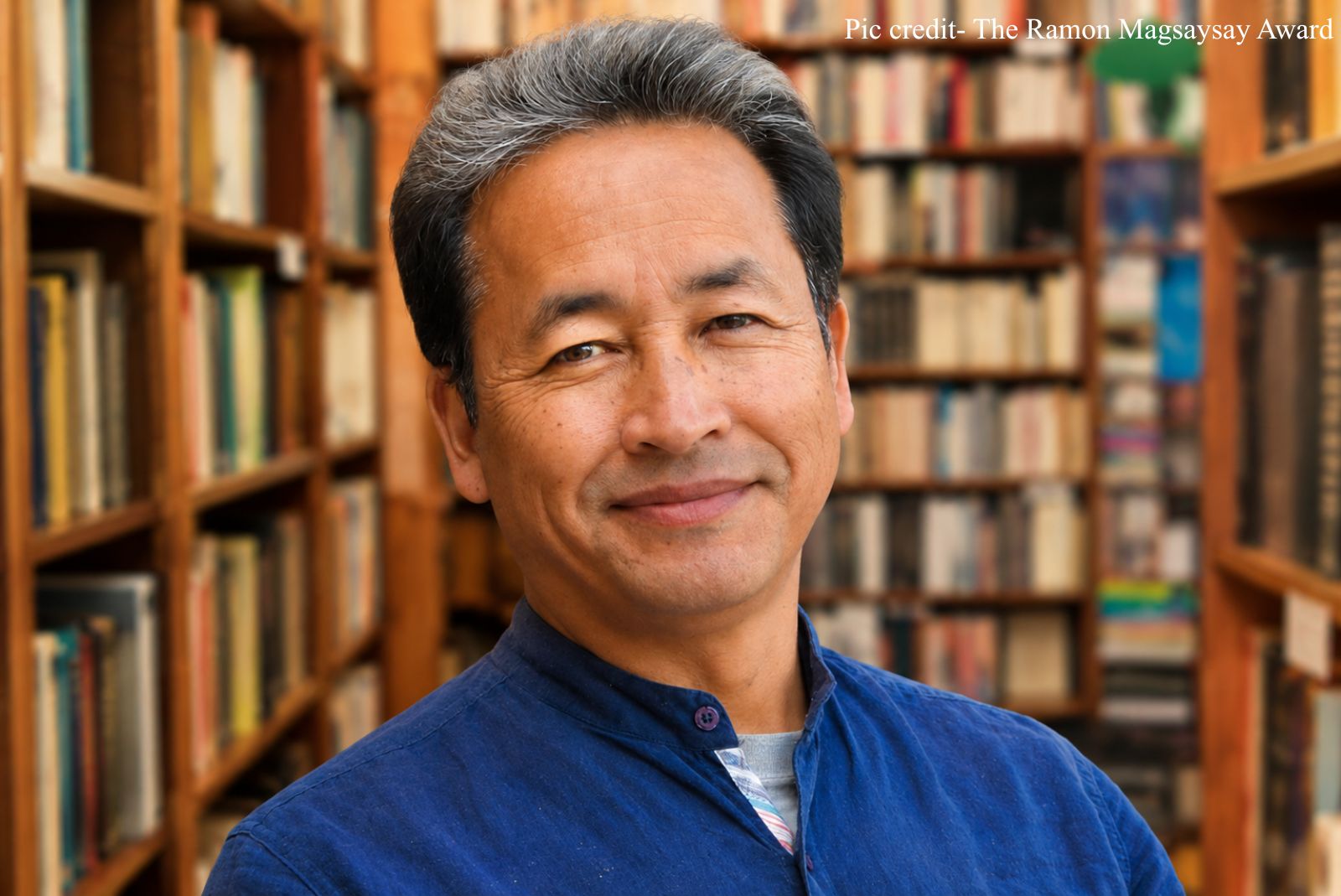
In the high-altitude cold desert of Ladakh, where freezing winds, scarce resources, and isolation shape everyday life, innovation is not a choice but a necessity. In such a demanding landscape, one individual turned local challenges into globally admired solutions through creativity and determination. That individual is Sonam Wangchuk, an engineer and reformer whose work has reshaped education and sustainable development in India.
Sonam Wangchuk was born in Ladakh, a region where harsh climatic conditions and limited infrastructure make access to quality education a significant challenge. During his early schooling, he experienced firsthand how conventional education systems often fail to connect with the realities of rural and remote students. Rote learning methods, language barriers, and lack of practical exposure made learning difficult, but these struggles also sparked his curiosity about how education could be redesigned to better serve students.
Motivated to find better answers, he pursued Mechanical Engineering from the National Institute of Technology Srinagar. His time in engineering strengthened his problem-solving mindset and deepened his belief that education should not only focus on theory but also on practical application that benefits society directly. This perspective later became the foundation of his life’s work.
After completing his studies, Sonam Wangchuk co-founded SECMOL (Students’ Educational and Cultural Movement of Ladakh), an alternative learning space created to challenge traditional schooling systems. SECMOL was built on the principle that students learn best when education is experiential, practical, and connected to real-world problems. Instead of focusing on rote memorization, it encourages independent thinking, collaboration, and hands-on problem-solving.
The SECMOL campus itself became an example of sustainable living and student-driven innovation. Designed with eco-friendly methods and active student participation, it demonstrates how education can also teach responsibility toward the environment. Many students who once struggled in mainstream schools found renewed confidence and purpose in this system, proving that learning becomes powerful when it is meaningful and contextual.
Beyond education reform, his focus expanded to one of Ladakh’s most urgent environmental challenges—water scarcity. In a region where agriculture depends heavily on glacier meltwater, climate change has made water availability increasingly unpredictable, directly affecting livelihoods and food security.
To address this issue, Sonam Wangchuk introduced the Ice Stupa concept. These artificial glaciers are created by freezing diverted winter stream water into large cone-shaped structures. Unlike natural glaciers that release water at unpredictable times, Ice Stupas are designed to melt gradually during spring and early summer, providing irrigation when farmers need it most.
This innovation gained worldwide recognition for its simplicity and effectiveness. It demonstrated that sustainable solutions do not always require complex or expensive technology; instead, they can emerge from a deep understanding of local environments and community needs.
Over the years, he has received several prestigious honors, including the Ramon Magsaysay Award, often referred to as Asia’s Nobel Prize. Despite international recognition, he continues to focus on grassroots innovation, education reform, and environmental sustainability rather than personal accolades.
Today, Sonam Wangchuk stands as a symbol of purposeful innovation and responsible development. His work continues to inspire students, educators, and innovators across the world to rethink how knowledge is used and how real change is created.
His journey reflects a powerful message: meaningful innovation begins when learning is connected to life, and when solutions are designed with both people and the planet in mind.